Think about the last song that made you feel something deep. Was it the way the singer described a memory like it was happening right now? Or did they paint a future that felt inevitable, like a storm you couldn’t escape? The way time moves in a song isn’t just background-it’s the backbone of emotion. Time and tense in songwriting don’t just tell you when something happened-they tell you how to feel about it.
Flashback: When the Past Haunts the Present
Many of the most powerful songs are built on memories. Not just any memories, but ones that still ache. Think of "Someone Like You" by Adele. She doesn’t say, "I used to love him." She sings, "I heard that you’re settled down," like the news just hit her in the chest. The past isn’t over. It’s alive in the room with her.Flashbacks in songwriting work because they create emotional dissonance. The listener hears the past through the lens of the present. That’s why songs like "The Night We Met" by Lord Huron hit so hard. The lyrics don’t just recall a moment-they make you feel the weight of lost time. "I didn’t know I’d miss you so much"-that line doesn’t belong in the past. It belongs in the silence after the last note.
Use flashback when you want to show regret, longing, or unresolved pain. Don’t just say, "Back then we were happy." Show the contrast. "You still wear that shirt I gave you / I still wear my old shoes." The details matter. The shirt. The shoes. The fact that they’re still there. That’s what turns a memory into a wound.
Present: The Immediate, Raw Moment
Nothing grabs attention like the here and now. When a song lives in the present tense, it feels urgent. Like you’re standing next to the singer. "I’m a mess," says Billie Eilish in "bad guy." Not "I was a mess." Not "I’ll be a mess." Right now. In this breath. In this heartbeat.Present tense is the weapon of honesty. It’s why "I Will Always Love You" by Whitney Houston still gives people chills. She doesn’t say, "I will always love you when I’m gone." She says it as she’s leaving. The choice to stay in the moment makes it feel like a final confession.
Use present tense when you’re writing about anger, desire, confusion, or sudden realization. It’s the tense of panic, of joy, of breaking down. "I’m shaking," "I can’t breathe," "I don’t know why I’m still here." These lines don’t need backstory. They’re the story.
Try this: Write a verse where everything happens right now. No flashbacks. No future plans. Just what’s happening in the room, in the car, in the silence between heartbeats. You’ll be surprised how much more real it sounds.
Future: The Promise, the Threat, the Unknown
The future in songs isn’t about optimism. It’s about dread. Or hope that’s too fragile to name. "I’ll be waiting" sounds sweet until you realize the person saying it might be alone forever. "I’ll be gone" sounds final until you realize they’re not leaving-they’re disappearing.Think of "I Will Survive" by Gloria Gaynor. It’s not a happy song. It’s a declaration of survival. "I’ve got all my life to live"-that’s not a celebration. It’s a vow. The future here isn’t a place. It’s a fight.
Future tense works best when it’s uncertain. "I’ll find you" sounds romantic. "I’ll find you before it’s too late" sounds like a threat. "I’ll be gone by morning" feels like a suicide note. The future tense doesn’t predict-it threatens, promises, or begs.
Use future tense when you want to build tension. When the listener needs to wonder: Will they make it? Will they stay? Will they change? Don’t say, "One day I’ll be free." Say, "I’ll be free when the lights go out." Now you’ve got a condition. A deadline. A reason to hold your breath.
Shifting Time: The Secret Weapon
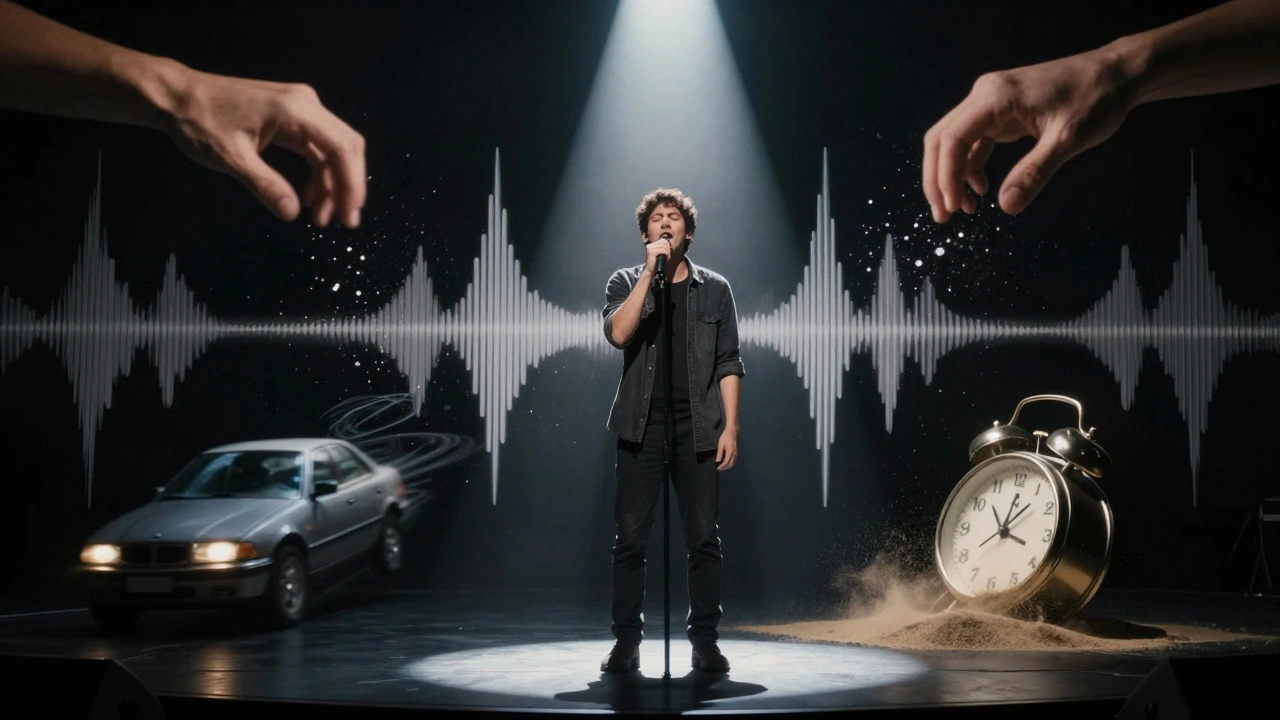
The most unforgettable songs don’t stick to one tense. They move. They twist. They jump.Look at "The Scientist" by Coldplay. It starts in the past: "Nobody said it was easy." Then shifts to present: "I’m going back to the start." Then to future: "I’m not the only one." The song doesn’t just tell a story-it rewinds, replays, and fast-forwards.
That’s the trick. Time shifts in songs aren’t random. They’re emotional triggers. A flashback to show what was lost. A present moment to show the pain is still real. A future line to show the hope-or the fear-is still alive.
Try this exercise: Write a three-line chorus where each line is a different tense.
- Line 1: Past - "We used to laugh until our sides hurt."
- Line 2: Present - "Now I laugh alone in the dark."
- Line 3: Future - "I’ll laugh again when the rain stops."
That’s not just a chorus. That’s a whole relationship in 15 words.
Why Tense Matters More Than You Think
Most songwriters focus on rhyme, melody, imagery. They forget time. But time is the invisible rhythm. It’s the pulse under the beat.When you choose your tense, you’re choosing how the listener experiences the emotion. Past tense = distance. Present tense = immersion. Future tense = anticipation.
Think about your favorite songs. How many of them would lose their power if you changed the tense? "Yesterday" by The Beatles? If it were "Tomorrow," it wouldn’t be a song. It would be a prediction. "I’m So Lonesome I Could Cry"? If it were "I was so lonesome," it would be a memory, not a scream.
Time isn’t just a tool. It’s a character in your song. And if you ignore it, your lyrics will feel flat-even if every rhyme is perfect.
Real Examples That Changed the Game
- "Hallelujah" by Leonard Cohen: Starts in the past ("I heard there was a secret chord") and drifts into timeless present. The tense doesn’t change because the emotion doesn’t either. - "Fast Car" by Tracy Chapman: The whole song is present. Every line feels like it’s happening right now. "You got a job. You got a car." Not "You had." Not "You’ll have." Right now. That’s why it feels so real. - "We Didn’t Start the Fire" by Billy Joel: Past tense, but not nostalgia. It’s a list of chaos. The past isn’t pretty-it’s overwhelming. The tense makes it feel like history is still spinning. - "All Too Well (10 Minute Version)" by Taylor Swift: The song shifts between past and present like a memory that won’t let go. "You kept my whole sweater / Though it was never mine." The present tense here doesn’t mean it’s happening now. It means it still matters.How to Use Time Like a Pro
1. Start with the emotion. Are you writing about loss? Use past. Are you writing about a moment of truth? Use present. Are you writing about a decision that could change everything? Use future. 2. Don’t mix tenses unless you mean to. Random shifts confuse the listener. A shift should feel intentional-like a flashback triggered by a smell, a sound, a name. 3. Let the music guide the tense. A slow, minor-key melody? Try past. A driving, urgent beat? Try present. A rising, hopeful chord progression? Try future. 4. Test it out loud. Read your lyrics as if you’re telling a friend. Does it sound like you’re remembering? Living? Planning? If it doesn’t feel real when you say it, it won’t feel real when someone hears it.Final Thought: Time Is the Only Thing You Can’t Rewrite
You can change the words. You can change the melody. But time? Time stays. And the way you use it in your lyrics tells the listener: this matters. This happened. This is still happening. This might never be over.So don’t just write what happened. Write how it still lives in you.
Can I use past tense in a love song without making it sound like it’s over?
Yes, but only if you show the past is still alive. Saying "We were happy" sounds final. Saying "I still wake up thinking about your laugh" turns the past into a present pain. The key is not the tense-it’s the detail. The sweater you still keep. The coffee cup you still use. Time doesn’t end a relationship. Silence does.
Why do some songs sound fake even when the lyrics are good?
Often because the tense doesn’t match the emotion. A song about heartbreak written in future tense (“I’ll get over you”) feels like a promise, not a wound. A song about joy written in past tense (“We had so much fun”) feels like nostalgia, not celebration. The listener feels the mismatch. It’s not about being poetic-it’s about being real.
Is present tense better for pop songs?
It’s not better-it’s more common. Pop songs thrive on immediacy. "I’m the one," "I’m feeling it," "I’m not sorry." These lines grab attention because they’re happening now. But that doesn’t mean past or future can’t work. Look at "All Too Well"-it’s mostly past tense, and it’s one of the biggest pop songs of the decade. What matters is whether the tense serves the story, not the genre.
Can I use future tense to create hope in a sad song?
Yes-but it has to feel earned. Don’t say, "I’ll be okay." That’s empty. Say, "I’ll be okay when I stop checking your number." That’s a condition. A step. A real change. Future tense works best when it’s tied to action, not wishful thinking. Hope isn’t a feeling. It’s a decision.
How do I avoid mixing tenses accidentally?
Read your lyrics out loud, line by line. If you catch yourself saying, "I was... I am... I’ll be..." in the same verse without a clear emotional reason, you’re mixing. Highlight each tense. If they’re scattered, you’re losing control. Pick one tense as your anchor. Then shift only when the emotion demands it.