Ever listen to a song and find yourself humming it hours later-even when you don’t know the lyrics? That’s not luck. That’s a well-crafted hook. The difference between a forgettable tune and one that sticks in your head comes down to two things: melodic leaps and contour. Most songwriters focus on chords or lyrics, but the real magic lives in how the melody moves. Let’s break it down.
What Is Melodic Contour?
Contour is the shape of a melody. Think of it like drawing a line with your voice. Does it rise slowly like a hill? Drop suddenly like a cliff? Curve gently like a river? The contour tells your ear what to expect-and when to pay attention.
Take the opening of "Happy" by Pharrell Williams. The melody starts low, climbs steadily, and holds at the top. It’s a smooth, upward arc that feels uplifting. That’s contour in action. Compare it to "Billie Jean" by Michael Jackson. The hook begins on a single note, then drops a fifth, then jumps back up. That unexpected drop-and-lift creates tension and release. Both are memorable, but they use contour in totally different ways.
Most amateur songwriters make melodies that stay flat or move in small steps. That’s safe-but boring. Your brain tunes out predictable patterns. To stand out, you need contrast.
The Power of Melodic Leaps
A melodic leap is when a note jumps to another note that’s not next door. A leap of a third, fifth, or even an octave. These jumps grab attention. They’re the sonic equivalent of a punchline.
Look at "Don’t Stop Believin’" by Journey. The hook starts with a leap of a sixth-from G to E. That’s bold. It’s not something you’d sing casually. It demands your ear. And then it resolves into a simple stepwise line. That contrast is why millions sing along.
Leaps work because they break expectation. Our brains love patterns, but they also love surprises. A leap says, "Hey, listen here." But if you leap too much, the melody feels chaotic. The trick? Use one big leap, then follow it with a gentle descent or stepwise motion. That’s the formula for hooks that stick.
How to Build a Hook Step by Step
Here’s a practical method to craft your own hooks using contour and leaps:
- Start with a short phrase-3 to 5 notes max. No need to overthink.
- Place your strongest word (like "love," "free," "go") on the highest note. That’s where attention lands.
- Introduce one melodic leap-try a fourth or fifth. Don’t use more than one leap per hook.
- After the leap, move stepwise down. This gives the ear a sense of resolution.
- Repeat the phrase, but shift the rhythm slightly. Change a quarter note to a dotted eighth. That subtle variation makes it feel alive.
Try it with a simple lyric like "I’m breaking free." Hum the notes. Put "free" on a high note. Jump up a fifth from the previous note. Then let the rest of the phrase fall back down. Now repeat it with a syncopated rhythm. That’s your hook.

Why Some Hooks Work and Others Don’t
Not all catchy melodies are created equal. A hook that works in pop might flop in country. Why? Context matters.
"Uptown Funk" by Mark Ronson and Bruno Mars uses a repetitive, syncopated hook with small leaps. It’s groovy, not soaring. It matches the funk vibe. Meanwhile, "Roar" by Katy Perry uses big leaps (a major seventh!) and a soaring contour to match the anthem feel.
Here’s the rule: Match your contour to your emotion.
- Upward contour → hope, joy, triumph
- Downward contour → sadness, release, reflection
- Flat contour → calm, steady, hypnotic
- Sharp leaps → surprise, energy, drama
When your melody’s shape matches the feeling of the lyrics, the hook hits harder. That’s why "I Will Always Love You" by Whitney Houston opens with a long, slow rise-it mirrors the weight of a goodbye.
Common Mistakes to Avoid
Even experienced writers mess this up. Here are the three biggest errors:
- Too many leaps → The melody feels jumpy and disjointed. Pick one big leap and let it breathe.
- No contrast → If every note moves the same way, your hook blends into the background. Add a leap where you least expect it.
- Ignoring rhythm → A great melodic shape can still fail if the rhythm is lazy. Try clapping the hook. If it doesn’t make you tap your foot, it’s not sticky enough.
Also, avoid writing hooks that are too long. Most chart-topping hooks are 2 to 4 seconds long. That’s less than a breath. If you can’t sing it in one exhale, shorten it.
Real-World Examples to Study
Listen to these hooks and trace their contour and leaps:
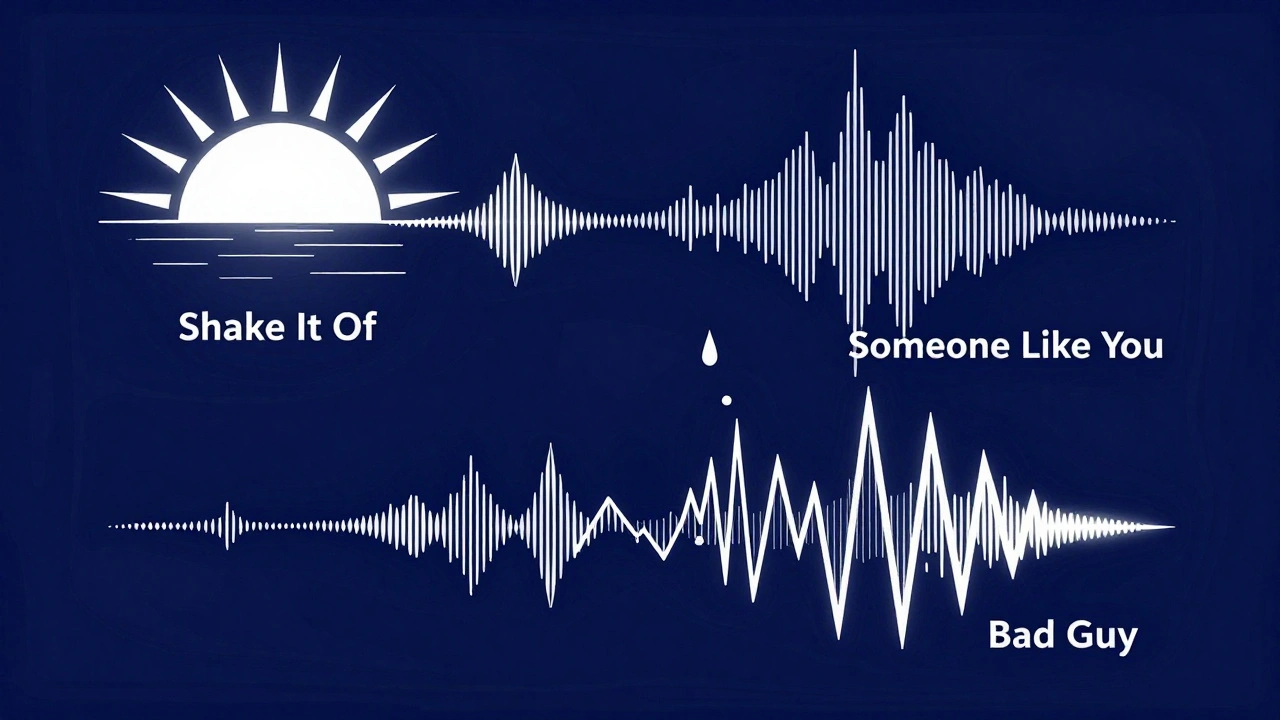
- "Shake It Off" by Taylor Swift - The hook "I shake it off" uses a rising third, then drops back. Simple, but effective.
- "Someone Like You" by Adele - The contour is mostly descending, with a single leap up on "never mind" that breaks your heart.
- "Bad Guy" by Lizzo - The bass line is the hook, but the vocal melody uses small leaps and a flat contour to create a sly, confident vibe.
- "Bohemian Rhapsody" by Queen - The "Mama, just killed a man" section uses dramatic leaps and shifting contours to match the emotional chaos.
Study these. Hum them. Write them down. Notice how each one uses contour and leap differently. That’s your training.
Final Tip: Test Your Hook Like a Pro
Here’s how to know if your hook works:
- Sing it without any accompaniment. Can you remember it after one try?
- Ask someone else to sing it back to you after hearing it once. If they get it wrong, simplify.
- Play it on a loop for 30 seconds. Does it still feel fresh? If it gets boring, it’s not strong enough.
- Strip away everything but the melody. If it still sounds like a hook, you’ve got it.
Memorable hooks aren’t about complexity. They’re about clarity, surprise, and emotional alignment. The best ones feel inevitable-like they were always meant to be that way.
So next time you’re stuck on a chorus, forget the chords. Forget the lyrics for a moment. Just hum. Let your voice find the shape. Let it leap. Let it fall. And listen. The hook is already there-you just need to recognize it.