Robert Hill’s mic locker isn’t just a closet full of gear-it’s a working archive of tones that shaped hundreds of recordings. If you’ve ever wondered why some vocals cut through a mix like glass and why some guitar amps sound like they’re breathing, the answer often starts with the mic. Hill, a producer and engineer based in Portland, has spent over 20 years chasing the right sound. He doesn’t chase trends. He chases response. Here’s what he actually uses when tracking vocals and electric guitar-and why.
Why the Mic Matters More Than You Think
A lot of producers think the preamp or the plugin does the heavy lifting. It doesn’t. The mic is the first and most important filter in the chain. It decides what frequencies get captured, how transients behave, and whether the source sounds alive or flat. Hill’s rule: if the mic doesn’t excite you when you hear it live, it won’t excite anyone in the mix.
Take a vocal session. A singer warms up with a simple phrase: “I can’t sleep.” That one line carries breath, texture, emotion. The mic you choose either amplifies that humanity or flattens it into something clinical. Same goes for a guitar amp. A cabinet loaded with a 10-inch speaker doesn’t just make noise-it vibrates air in a way that’s physically unique. The mic catches that movement, not just the sound.
Robert Hill’s Top 3 Vocal Mics
Hill doesn’t have a single go-to vocal mic. He picks based on the voice, the song, and the room. But three mics show up in over 80% of his vocal sessions.
- Shure SM7B - This is his default for male baritones and gritty rock vocals. It’s not flashy. It doesn’t add sparkle. But it tames sibilance, blocks room noise, and gives that warm, close-up presence you hear on classic metal and hip-hop records. Hill often pairs it with a Cloudlifter CL-1 because the SM7B needs gain. He says, “It’s the mic that makes lazy singers sound like they’re giving everything.”
- Telefunken U47 FET - For smooth, soulful, or cinematic vocals, he reaches for this. It’s a modern reissue of the ’60s classic, and it adds a subtle harmonic bloom that makes voices feel larger than life. He uses it on female singers with lower registers-think Norah Jones or H.E.R.-and on spoken-word poetry tracks. The U47 FET doesn’t just capture the voice; it makes it feel like it’s in the room with you.
- Audio-Technica AT4050 - This is his Swiss Army knife. A multi-pattern condenser that handles high SPLs and has a flat, accurate response. Hill uses it when he needs flexibility: layered harmonies, choir stacks, or when the singer moves around a lot. It doesn’t color the voice, but it doesn’t hide it either. “It’s the mic I use when I’m not sure what I want yet,” he says.
How He Mics Electric Guitar Cabinets
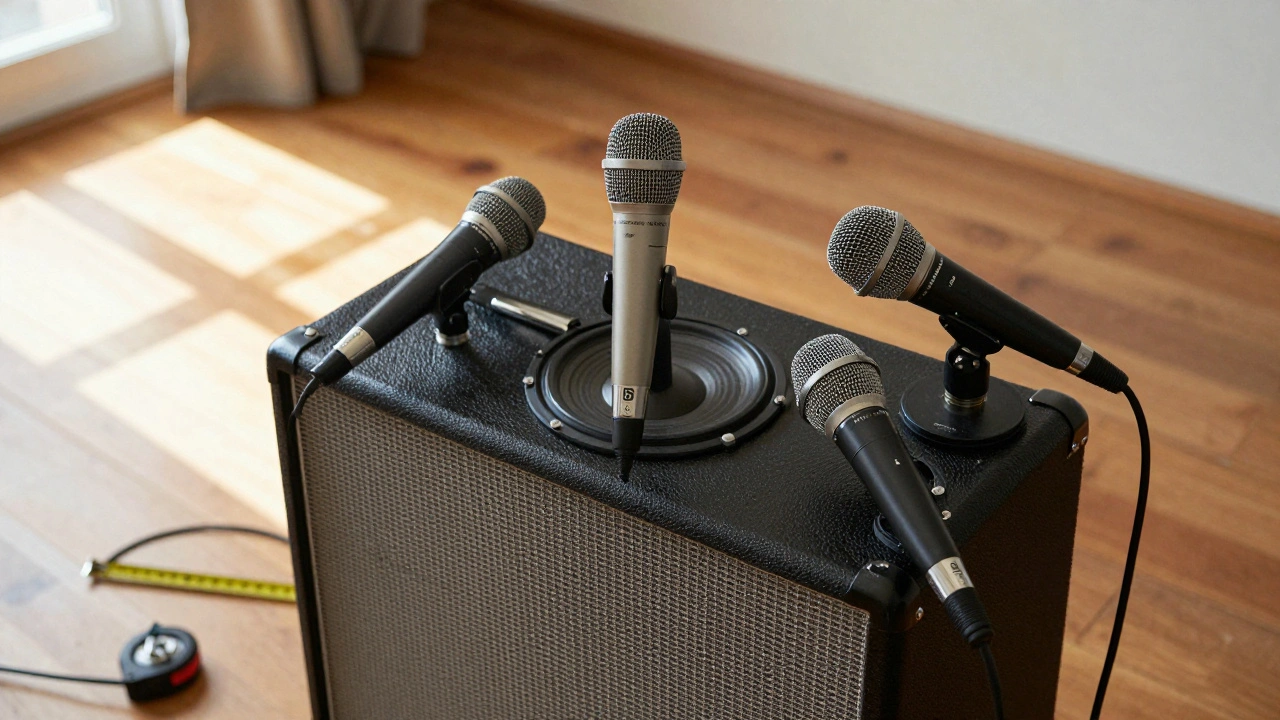
Electric guitar is where Hill gets weird. He doesn’t just stick one mic in front of the amp. He layers. Always.
His standard setup:
- Shure SM57 - Placed dead center on the speaker cone. This is his reference point. The 57 has a midrange hump that cuts through dense mixes. It’s not sweet, but it’s reliable. He says, “If the 57 doesn’t work, nothing will.”
- Electro-Voice RE20 - Positioned 6 inches back, angled slightly off-axis. This dynamic mic smooths out the harshness of overdriven amps. It’s great for blues, country, and anything with a lot of sustain. The RE20’s proximity effect adds body without muddiness.
- Neumann TLM 103 - A condenser placed 18 inches back, pointed at the edge of the speaker. This captures room tone and air. It’s not for crunch. It’s for dimension. Hill blends this in at 10-15% to give the guitar space. “It’s like the difference between a photo taken in a studio and one taken in a cathedral,” he explains.
He rarely uses more than three mics on guitar. Too many mics = phase chaos. He always checks phase alignment with a simple trick: flip the polarity on one mic and listen. If the sound gets thinner, he leaves it flipped. If it gets fuller, he keeps it normal.
What He Avoids
Hill doesn’t use ribbon mics on loud guitar amps. Not because they’re fragile (though they are), but because they roll off too much high end. He’s tried them on clean tones, and while they sound gorgeous, they lose the attack. “You want to hear the pick hit the string,” he says. “Not the ghost of it.”
He also avoids cheap condensers on vocals. A $100 USB mic might be fine for podcasts, but it collapses under dynamic singing. “I’ve heard singers try to belt over a track with a $50 mic, and the result? A voice that sounds like it’s underwater. No amount of compression fixes that.”
Room Matters More Than Price
One of Hill’s most unpopular opinions: the best mic in the world sounds bad in a bad room. He’s had clients bring in a $3,000 Neumann and walk away disappointed. Why? Because the room was a concrete box with a fluorescent light buzzing overhead.
He doesn’t treat every room like a studio. He uses what’s there. In his home studio, he hangs blankets behind the singer. He puts a bass trap in the corner. He records vocals at 3 a.m. when the street noise dies. “The mic picks up everything,” he says. “Even the fridge.”
For guitar, he records in a room with wood floors and a high ceiling. It gives natural reverb without ringing. He’s turned closets into vocal booths. He’s taped foam to the ceiling of a garage. It’s not about gear-it’s about controlling what the mic hears.
Real-World Examples
On a recent indie rock album, Hill tracked the lead vocal with the SM7B, but the backing harmonies with the AT4050. Why? The SM7B gave the lead voice weight and intimacy. The AT4050 let the harmonies breathe and sit evenly across the stereo field.
For a blues record, he miced a Fender Deluxe Reverb with the SM57 and RE20. He didn’t use the TLM 103 because the room was too small. Instead, he placed a Shure Beta 52A on the floor, pointing up at the amp. It picked up the low-end thump you feel in your chest. He blended it in at 8%. The result? A guitar tone that didn’t just sound loud-it felt physical.
Final Advice: Start Simple
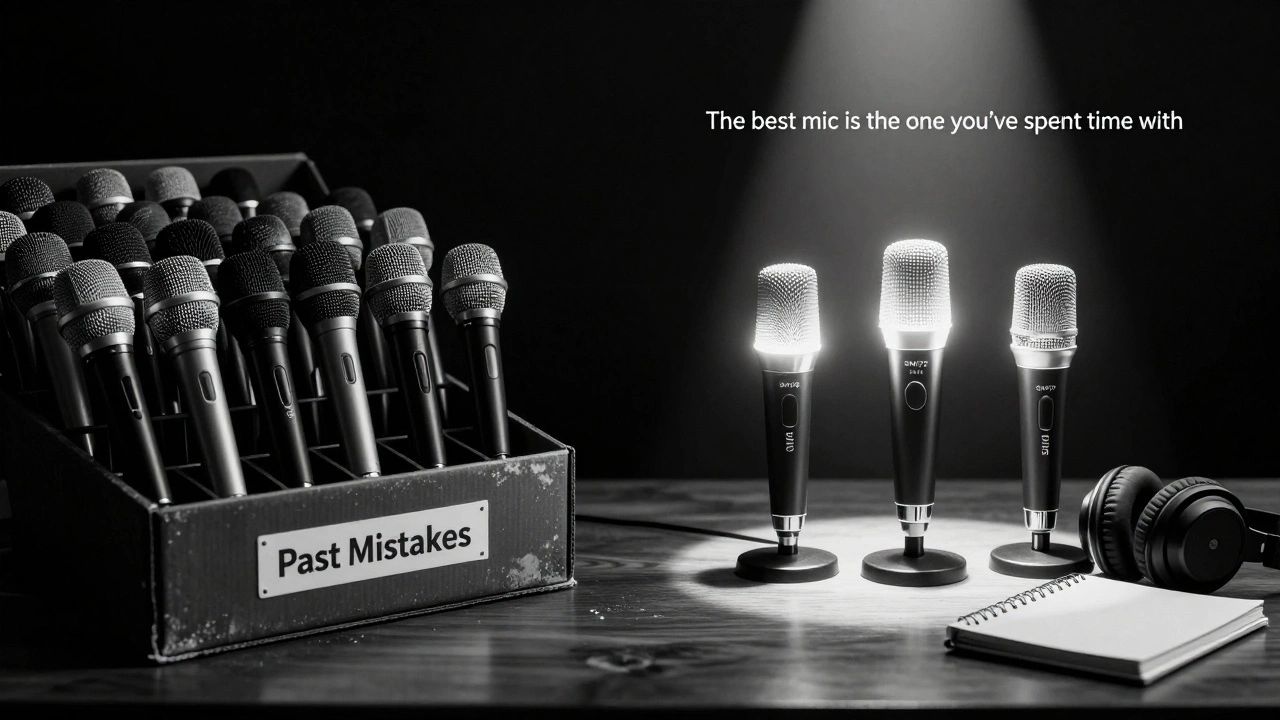
Hill’s biggest mistake early in his career? Overcomplicating things. He’d buy a new mic for every session. He ended up with 40 mics and zero consistency.
Now, he owns 12. He knows them all. He uses three for vocals. Two for guitar. Everything else sits in a box.
If you’re starting out, don’t buy a whole rack. Get one vocal mic and one guitar mic. Learn them. Live with them. Break them in. The SM7B and SM57 are the most common pair for a reason. They’re durable. They’re affordable. And they work on almost everything.
“The best mic is the one you’ve spent time with,” he says. “Not the one you just rented.”
What’s the best microphone for beginners recording vocals at home?
For beginners, the Shure SM7B is the most forgiving and versatile option. It handles plosives, sibilance, and room noise better than most condensers. Pair it with a Cloudlifter CL-1 for clean gain, and record in a quiet space-even a closet works. You don’t need expensive gear to get professional-sounding results if you focus on mic placement and environment.
Can I use the same mic for guitar and vocals?
Yes, but with limits. The Shure SM57 works well on both, especially if you’re just starting out. It’s great for bright guitar tones and can handle loud vocals. However, it lacks the low-end warmth and high-end detail of dedicated vocal mics like the SM7B or U47. For best results, use one mic for vocals and another for guitar. But if you’re on a budget, the SM57 is a solid compromise.
Why do some mics sound better on certain voices?
Every voice has a unique frequency profile. A bright, nasal voice might sound harsh on a mic with too much high-end presence, like a condenser with a treble boost. A deep, mellow voice might disappear on a mic that rolls off low frequencies. Mics like the SM7B and U47 FET are designed to enhance natural tone rather than alter it. The goal isn’t to make the voice sound “better”-it’s to make it sound like itself, just more present.
Do I need a preamp for my mic?
You need gain, not necessarily a fancy preamp. The SM7B and RE20 are low-output dynamics-they need +20 to +30 dB of clean gain. A basic audio interface might not cut it. A Cloudlifter CL-1 or Triton FetHead adds gain without noise and costs less than $100. You don’t need a $500 preamp unless you’re chasing color. For clarity, focus on clean gain first.
Is it better to use one mic or multiple mics on a guitar amp?
One mic can sound amazing if placed well. Two mics give you more control: one for attack (SM57), one for body (RE20 or TLM 103). Three mics is usually overkill unless you’re recording for a film score or complex production. Phase issues are the biggest risk. Always check phase alignment by flipping polarity on one mic. If the sound gets thinner, flip it back.