There’s a quiet tension in the blues world that few talk about: the gap between what scholars write and what players actually do on stage. You can read every book on Robert Johnson’s tuning, analyze every lick in B.B. King’s solos, and still walk into a juke joint and realize you’ve never heard the real thing. Blues isn’t just notes on paper. It’s sweat, silence, and the way a guitarist pauses just a half-beat too long before bending the string. That’s where theory ends and truth begins.
The Scholar’s Blues
Blues scholarship has done incredible work preserving what might’ve been lost. Researchers like Alan Lomax recorded field sessions in the 1930s, capturing musicians who’d never seen a studio. Scholars later decoded the call-and-response patterns in Delta blues, traced the African roots of blue notes, and mapped how economic hardship shaped lyrical themes. Books like Deep Blues by Robert Palmer and The Blues Line by David Evans laid out the architecture of the genre - chord progressions, scales, regional styles, and lyrical motifs.
But here’s the catch: scholarship often treats the blues like a fossil. It freezes it in time. A paper might say, "The 12-bar blues uses I-IV-V chords in a specific order." That’s true. But it doesn’t tell you why Sonny Boy Williamson II would stretch the fourth bar into six, or why Howlin’ Wolf sometimes skipped the V chord entirely to make the tension feel heavier. Those choices weren’t mistakes. They were emotional adjustments. And you won’t find them in footnotes.
The Stage’s Blues
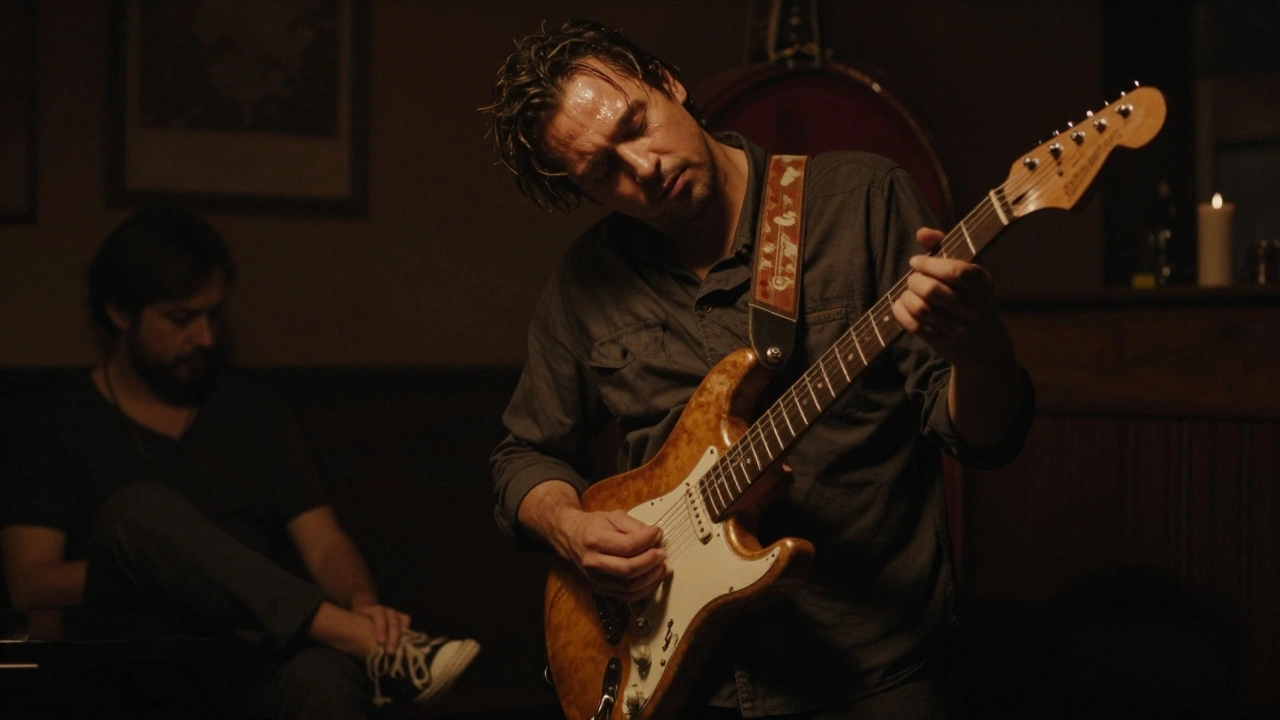
Go to any Saturday night jam in Clarksdale, and you’ll see something different. A guitarist might start a song in E, then shift halfway through to D because the singer’s voice cracked on the high note. The drummer doesn’t count bars - he listens. He waits for the slide to wobble, then drops a fill that sounds like a dog barking at a train. The bassist doesn’t follow sheet music; he follows the vibe. That’s not chaos. That’s adaptation.
Stage practice teaches what no textbook can: timing is physical. A blues lick doesn’t land because it’s mathematically correct - it lands because the room breathes with it. You learn this by playing until your fingers bleed. You learn it when a drunk man in the back shouts "More pain!" and you know exactly what he means. You learn it when you play the same progression for the third night in a row and suddenly, without thinking, you add a note you’ve never played before - and it works.
One veteran player in Memphis told me, "I didn’t learn blues from records. I learned it from watching how the old guys looked at their shoes when they played the third chord. If they stared at their shoes, you knew they were about to slide into the next note. If they looked at the ceiling, you held back. You didn’t need a theory book. You needed eyes."

Where the Two Worlds Collide
Some scholars dismiss stage practice as "unstructured." Some players dismiss scholarship as "overthinking." But the real power comes when they meet.
Take the minor pentatonic scale. Scholars say it’s the backbone of blues lead guitar. That’s accurate. But stage players know there’s a sixth note hiding in there - the flattened fifth, the "blue note." It’s not in the scale diagram. It’s in the space between the notes. You don’t find it by studying intervals. You find it by bending a string until it groans.
There’s a famous recording of Muddy Waters playing "Hoochie Coochie Man" in 1954. The studio version is clean. The live version from a Chicago club three months later? The guitar wobbles. The harmonica cracks. The bassline drags. Scholars have analyzed both versions. They note the tempo difference: 82 BPM vs. 76 BPM. But the real insight? The slower tempo wasn’t a mistake. It was a response. The room was hot. The crowd was tired. Muddy slowed it down to let the ache settle in. That’s not theory. That’s empathy.
What Gets Lost When We Choose One Side
When blues education focuses only on theory, it becomes a museum exhibit. Students learn to play "correctly" - clean licks, perfect timing, textbook phrasing. But they never learn how to make someone feel something. They can name every variation of the shuffle rhythm, but they can’t tell when to hold back.
On the flip side, players who reject theory often repeat the same patterns. They never expand. They don’t know why their favorite lick works - they just know it does. They miss out on deeper roots: how the blues scale evolved from West African tonal systems, or how the call-and-response structure mirrors church hymns and work songs. They play the form, but not the soul.
The most powerful blues musicians - people like Buddy Guy, Koko Taylor, or even modern players like Gary Clark Jr. - don’t choose one side. They let scholarship inform their playing, and let their playing reshape what scholarship means. Clark doesn’t just play blues. He rewrites it with rock, funk, and soul - and scholars now study how he bends genre lines. That’s the cycle: experience teaches theory, and theory gives context to experience.
How to Bridge the Gap
You don’t need a PhD to understand the blues. But you do need both hands: one on the fretboard, one on the book.
- Start with one classic recording - say, John Lee Hooker’s "Boogie Chillen." Listen to it 10 times. Then find the sheet music. Compare what you hear to what’s written. Notice the gaps.
- Play along with live recordings, not studio ones. Live tracks have mistakes, crowd noise, breaths - those are the real clues.
- Find a local blues jam. Don’t play to impress. Play to listen. Watch how the older players react to each other. That’s the unspoken language.
- Read one chapter from a blues history book, then go play. Let the theory sit in your fingers. Does it change how you bend a note? Does it make you pause differently?
The blues doesn’t live in libraries or in clubs. It lives in the space between them.
Why This Matters Now
In 2026, the blues is more than nostalgia. It’s a living language. Streaming services list over 400,000 blues tracks. Young musicians in Berlin, Tokyo, and Buenos Aires are learning the blues - not because it’s old, but because it’s honest. They’re blending it with hip-hop, electronic beats, and traditional folk. But they’re also losing something: the weight behind the notes.
Without understanding the history - the sharecropping, the migration, the church, the loneliness - the music becomes decoration. And decoration doesn’t move people. Truth does.
The next generation of blues players won’t be the ones who memorized the most licks. They’ll be the ones who learned to listen - to the records, to the room, to the silence between the notes.
Can you learn blues without studying theory?
Yes, you can learn to play blues by ear and repetition - many legendary players did. But without understanding the roots - the African rhythms, the work songs, the church influences - you’re playing the outline, not the story. Theory gives context. It doesn’t make you play better. It makes you play with meaning.
Is stage experience more important than formal training?
In blues, experience is the teacher. Formal training can help you read charts or understand harmony, but the real lessons - how to hold a note, when to leave space, how to respond to a crowd - only come from playing live. The best players combine both: they know the rules so they can break them purposefully.
Why do blues scholars focus so much on Robert Johnson?
Robert Johnson is a symbol, not a blueprint. His recordings are rare, his life is mysterious, and his influence is massive. Scholars study him because he’s a turning point - he blended Delta styles with urban elements, and his guitar work became a template. But he wasn’t the only one. Many better players from his time were never recorded. Focusing only on him risks turning blues into a myth, not a living tradition.
Do blues musicians still use the same scales today?
Yes, the minor pentatonic and blues scale are still the foundation. But modern players layer them with other scales - mixolydian, dorian, even chromatic passing tones. The core is the same, but the expression has evolved. A 1950s Chicago blues player might use one blue note. A 2026 player might use three, depending on the mood. The scale didn’t change. The feeling did.
What’s the biggest mistake new blues players make?
Trying to sound like a record. Blues isn’t about copying licks. It’s about telling your own story. The best players don’t sound like B.B. King or Muddy Waters - they sound like themselves, shaped by those who came before. If you’re playing to impress, you’re missing the point. Play to connect.