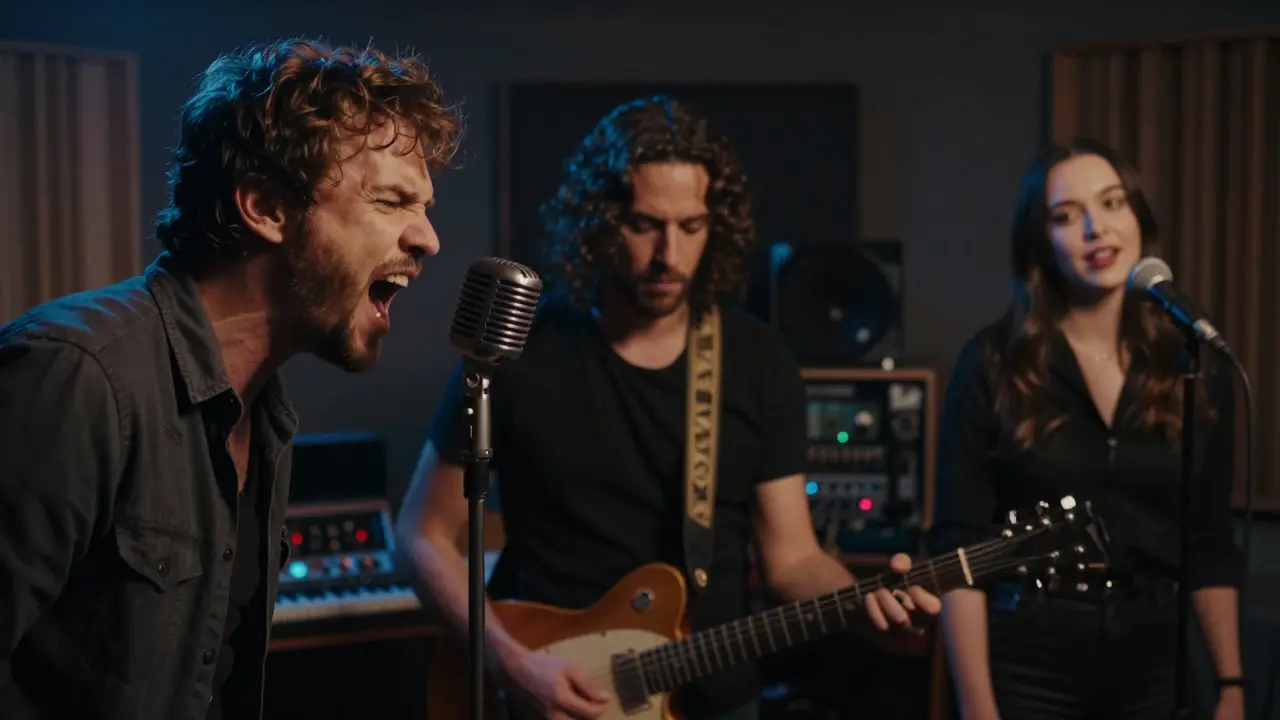
When you hear a contemporary blues track that feels both ancient and instantly modern, it’s rarely one person doing all the heavy lifting. It’s usually a conversation between voices. That’s exactly what happens when Robert Hill steps into the studio with collaborators like S.JĀ and Rae Simone. These aren’t just guest spots; they’re structural elements that reshape how the music breathes.
Hill has built a reputation not just for his guitar work or songwriting, but for his ability to curate vocal chemistry. In an era where many artists stick to their lane, Hill actively seeks out distinct tonal colors to expand his sonic palette. The result is a body of work that defies simple genre labels, blending traditional blues structures with soulful textures and modern production sensibilities.
The Chemistry of Collaboration
Why does this matter? Because vocals are the emotional anchor of any blues record. A single voice can carry a story, but two or three voices can create a dialogue. When Hill works with S.JĀ, he’s tapping into a raw, gritty energy that complements his own smoother delivery. Conversely, Rae Simone brings a polished, R&B-inflected warmth that softens the edges of harder tracks. This contrast isn’t accidental; it’s a deliberate artistic choice designed to keep the listener engaged.
Think of it like mixing paint. If you only use blue, you get blue. But if you add red, you get purple. If you add yellow, you get green. Hill uses these vocalists as his pigments. He doesn’t ask them to sound like him. He asks them to sound like themselves, then weaves those unique identities into his compositions. This approach prevents the music from feeling static or repetitive, even across multiple albums.
Working with S.JĀ: Grit and Authenticity
S.JĀ represents the "street" side of the blues equation. His vocal style is characterized by a raspy texture and an urgent delivery that evokes the classic Delta and Chicago blues traditions. However, unlike purists who might reject modern influences, S.JĀ embraces the present tense. His collaborations with Hill often feature lyrics that speak to current urban realities while maintaining the rhythmic backbone of traditional blues shuffles.
In their joint sessions, the dynamic is often call-and-response. Hill sets the harmonic foundation with his guitar, and S.JĀ reacts with improvisational bursts. This creates a live, spontaneous feel even in recorded settings. Fans of this pairing often note that the tension between Hill’s controlled precision and S.JĀ’s loose phrasing creates a magnetic pull. It’s rough around the edges, but in the best way possible.
- Vocal Texture: Raspy, gritty, high-energy.
- Lyrical Focus: Urban struggles, resilience, raw emotion.
- Musical Role: Provides contrast to Hill’s smoother tone.
- Key Tracks: Often featured on songs with faster tempos and heavier guitar riffs.
Partnering with Rae Simone: Soul and Smoothness
If S.JĀ brings the fire, Rae Simone brings the water. Her background in R&B and soul music allows her to glide over complex chord changes that might trip up a traditional blues singer. When she joins Hill’s projects, the tempo often slows down, and the focus shifts to melody and lyrical nuance. Her voice adds a layer of sophistication that broadens the appeal of Hill’s catalog to listeners who might not typically tune into blues radio.
The collaboration here is less about confrontation and more about complementarity. Simone’s harmonies often sit above Hill’s lead lines, creating a rich, layered soundscape. This technique is particularly effective in ballads or mid-tempo tracks where space and breath are essential. It shows that contemporary blues isn’t just about screaming into a microphone; it’s also about subtlety and control.
- Vocal Texture: Smooth, warm, melodic.
- Lyrical Focus: Love, loss, introspection, hope.
- Musical Role: Adds harmonic depth and accessibility.
- Key Tracks: Featured prominently in slower, reflective pieces.
Comparing the Two Approaches
To understand why Hill values both partnerships so highly, it helps to look at how they function differently within his discography. They serve opposite purposes, yet both are vital. Without S.JĀ, the music might feel too polished. Without Rae Simone, it might feel too harsh. Together, they cover the full spectrum of human emotion that blues music aims to capture.
| Attribute | S.JĀ | Rae Simone |
|---|---|---|
| Vocal Style | Gritty, Raw, Urgent | Smooth, Melodic, Warm |
| Primary Influence | Traditional/Delta Blues | R&B/Soul |
| Typical Tempo | Fast/Mid-Tempo | Slow/Mid-Tempo |
| Emotional Tone | Angst, Resilience | Comfort, Introspection |
| Role in Arrangement | Contrast/Tension | Harmony/Resolution |
The Impact on Contemporary Blues
This collaborative model is changing how people perceive contemporary blues. For decades, the genre was often viewed as a museum piece-something to be preserved rather than evolved. By bringing in voices from adjacent genres, Hill proves that blues is still a living, breathing language. It can absorb new influences without losing its core identity.
Listeners who discover Hill through these collaborations often find themselves exploring other artists in the same vein. It creates a ripple effect. A fan of Rae Simone’s smoothness might check out other soul-blues fusions. A fan of S.JĀ’s grit might dive deeper into electric blues history. Hill acts as a bridge, connecting disparate musical communities through shared respect for the blues form.

What Listeners Should Listen For
If you’re new to Robert Hill’s work, start with tracks that feature both collaborators or listen to the specific albums where each shines. Pay attention to how the vocal dynamics shift. Notice how the guitar arrangement adapts to support the different vocal textures. In songs with S.JĀ, listen for the interplay between the guitar riff and the vocal cadence. In songs with Rae Simone, listen for the spacing and the subtle ad-libs that fill the silence.
Also, consider the production choices. Modern recording techniques allow for cleaner separation of instruments, which makes the vocal nuances even more prominent. You can hear every crack in S.JĀ’s voice and every breath in Simone’s delivery. This transparency is part of the charm. It reminds you that these are real humans making music, not just digital files.
Frequently Asked Questions
Who is Robert Hill in the context of contemporary blues?
Robert Hill is a guitarist, songwriter, and producer known for blending traditional blues structures with modern production and diverse vocal collaborations. He is recognized for his ability to curate distinct vocal chemistries that expand the emotional range of his music.
How does S.JĀ’s style differ from Rae Simone’s?
S.JĀ offers a gritty, raw, and urgent vocal style rooted in traditional blues, often used in faster-paced tracks. Rae Simone provides a smooth, melodic, and warm R&B-influenced voice, typically featured in slower, more reflective songs. Their styles provide contrasting emotional tones to Hill’s music.
Why are vocal collaborations important in contemporary blues?
Vocal collaborations help keep the genre fresh and accessible. By incorporating different vocal textures and backgrounds, artists like Robert Hill can appeal to broader audiences while maintaining the core essence of blues. It demonstrates that the genre is evolving and capable of absorbing new influences.
What kind of music should I expect from these collaborations?
Expect a mix of electric blues, soul, and R&B. Tracks featuring S.JĀ will likely be higher energy with heavier guitar riffs, while tracks with Rae Simone will be smoother with a focus on melody and harmony. Both maintain strong blues foundations but explore different emotional landscapes.
Does Robert Hill write the songs for these collaborations?
While specific songwriting credits vary, Hill is generally the primary architect of the musical structure and production. He often invites collaborators to contribute to the lyrical direction or vocal arrangements, creating a true partnership rather than a simple guest appearance.