Sliding into a blues note should feel like breathing - smooth, controlled, and full of feeling. But if your slide guitar playing sounds shaky, out of tune, or lifeless, you’re not alone. Most players spend hours practicing scales and licks but skip the real foundation: intonation, vibrato, and sustain. These three elements don’t just make your playing sound professional - they turn notes into stories. Here’s how to build them with real, daily routines that actually work.
Why Intonation Is Everything in Slide Guitar
Unlike fretted guitar, slide guitar has no physical markers telling you where the note is. You’re sliding over a smooth neck, and even a 1/8-inch shift can turn a perfect G into a sour mess. That’s why intonation isn’t just important - it’s non-negotiable.
Start with a simple exercise: play the open E string, then slide up to the 12th fret (the octave). Use a tuner or a reference track. Don’t just slide - listen. Pause when you hit the exact pitch. Do this slowly, with your eyes closed. You’re training your ear and your fingers to find the sweet spot without looking.
Now try this: slide from the 7th to the 9th fret on the B string. That’s a whole step. Most players overshoot. The note should ring clear, not buzz or wobble. Repeat 10 times. If you hit the target 7 out of 10 times, you’re doing well. If it’s 3 out of 10, you need more work. This isn’t about speed - it’s about accuracy.
Try this daily: 5 minutes of sliding between half-steps (like 5th to 6th fret) on the high E and B strings. Use a drone tone from a phone app. Your slide must match the drone perfectly. No exceptions.
Vibrato: The Heartbeat of the Blues
Vibrato on slide isn’t shaking the slide back and forth like a guitar pick. That’s not vibrato - that’s noise. True slide vibrato comes from your wrist, not your arm. It’s a tiny, controlled rocking motion that makes the note breathe.
Place your slide on the 10th fret of the G string. Play the note. Now, without lifting the slide, rock your wrist back and forth - just enough to change the pitch by about a quarter-tone. Think of it like a singer holding a note and gently wavering it. Too much and it sounds like a siren. Too little and it’s dead.
Try this routine: hold a note for 8 counts. On count 3, start the vibrato. Keep it steady until count 8. Do this on every string, every fret between the 5th and 12th. Use a metronome set to 60 BPM. One note per beat. No rushing.
Listen to Albert King. He barely moved his slide, but every note pulsed. That’s the goal. You don’t need wide shakes. You need control. Record yourself. If it sounds like a drunk bee, start over. It’s okay to sound bad at first. The point is to feel the difference between a flat, lifeless note and one that sings.
Sustain: Let the Note Live
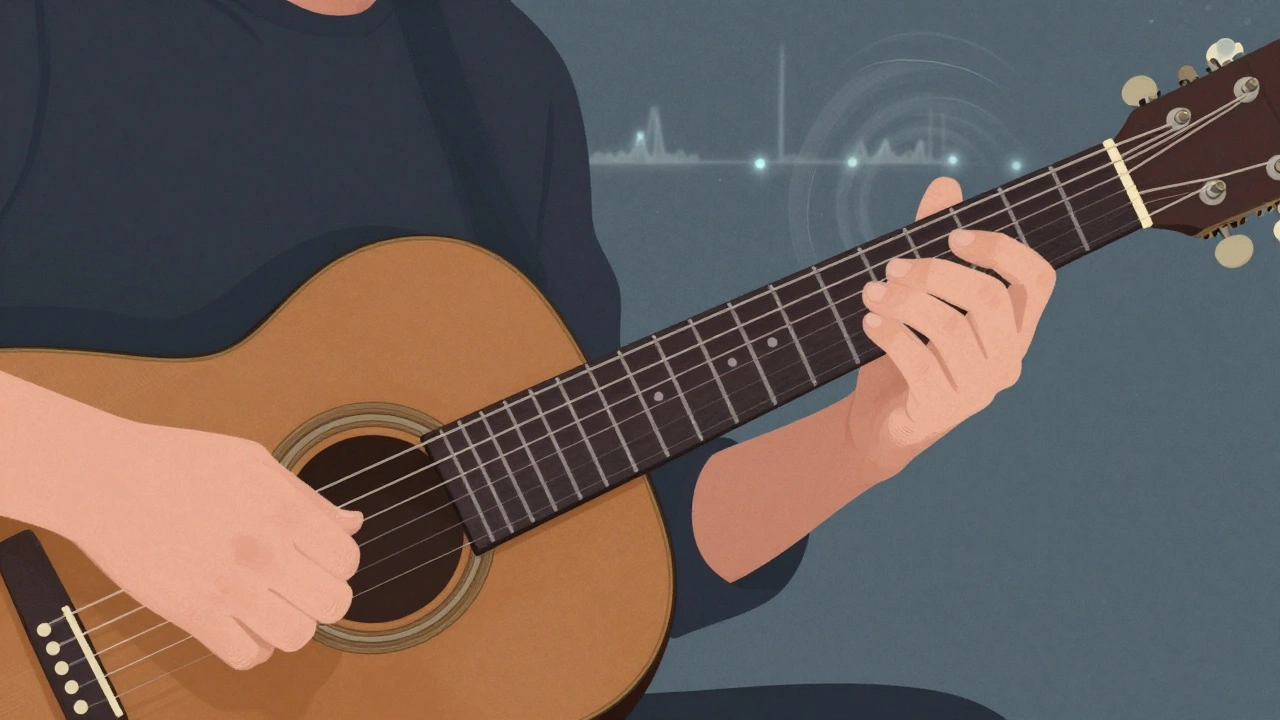
Sustain isn’t about volume. It’s about resonance. A slide note that dies too fast sounds thin. The goal is to make the note ring out like a bell - long, clear, and full.
Here’s the secret: your slide needs to be perfectly perpendicular to the strings. If it’s tilted, only one string rings. If it’s too light, the note fades. Too heavy, and you mute everything. The sweet spot? Just enough pressure to make contact without crushing the string.
Try this: play a single note on the 7th fret of the D string. Let it ring. Count how long it lasts. Aim for 6 seconds. Use a glass or metal slide - ceramic slides don’t sustain as well. Your fingers behind the slide should be relaxed, not gripping. Tension kills resonance.
Now, play a long note and let it fade naturally. Don’t cut it off. Let it die on its own. Repeat this 10 times. Pay attention to how the tone changes as it decays. You’re learning to shape the decay, not just start the note.
Try this in context: play the opening of B.B. King’s ‘The Thrill Is Gone.’ Hold the first slide note. Don’t move. Just listen. How long does it sustain? Now try to match it. You’ll hear the difference between a note that ends and a note that lingers.
Putting It All Together: The Daily Routine
You don’t need to practice for hours. Just 15 minutes a day, done right, will transform your playing.
- Minute 1-3: Intonation Drill - Slide between half-steps on the B and high E strings. Use a drone. Hit every note dead center.
- Minute 4-8: Vibrato Training - Hold a note on each string between frets 5 and 12. Add controlled wrist vibrato. Use a metronome.
- Minute 9-12: Sustain Focus - Play long notes on the D and G strings. Let them ring. Count the decay. Aim for 6+ seconds.
- Minute 13-15: Blues Phrase - Play a simple 12-bar blues lick using just three notes. Apply all three techniques: precise intonation, subtle vibrato, long sustain. Record it. Listen back. Improve next time.
Do this every day for two weeks. You’ll notice your slides are cleaner, your notes sing longer, and your vibrato starts to sound like you instead of a copy. That’s when the magic happens - when technique becomes expression.
Tools That Help
You don’t need fancy gear, but some tools make practice easier:
- Slide material: Glass slides (like the Dunlop Glass) give warm sustain. Metal (like the Dunlop Nickel) gives more cut. Try both.
- Tuner app: Use a chromatic tuner with a slow-response mode. It helps you hear pitch drift.
- Drone app: Free apps like ‘Drone Tone’ let you play a steady E or A note to match against.
- Metronome: Set to 60 BPM for slow, controlled practice.
Don’t overcomplicate it. Your hands and ears are the most important tools.
Common Mistakes to Avoid
- Using too much pressure - it kills sustain and mutes adjacent strings.
- Sliding too fast - speed hides bad intonation. Slow down.
- Ignoring the fretboard - always know where your slide is relative to the frets.
- Forgetting the left hand - your fingers behind the slide help stabilize and mute unwanted noise.
- Practicing without listening - if you’re not recording or comparing to recordings, you’re guessing.
The blues isn’t about how many notes you play. It’s about how well you play the ones you choose. Master these three elements, and every slide will carry weight, soul, and truth.
What slide material is best for blues?
Glass slides (like Dunlop Glass) give warm, singing sustain and are great for slow blues. Metal slides (like Dunlop Nickel) have more attack and cut through a band, ideal for faster, punchy styles. Many players keep both and switch based on the song.
Can I practice slide guitar without a slide?
Not really. Slide technique depends entirely on the physical interaction between the slide and the string. You can practice finger positioning and ear training without one, but you won’t develop the muscle memory needed for real slide playing. Get a slide - even a cheap one - and start using it daily.
Why does my slide sound buzzy?
Buzzing usually means your slide isn’t perpendicular to the strings or you’re pressing too lightly. Make sure the slide is flat across all strings and use just enough pressure to make contact. Also check your guitar’s action - if the strings are too low, buzz is inevitable. A setup from a luthier can fix this.
How long should I hold a note to build sustain?
Aim for at least 6 seconds. That’s long enough to train your ear and fingers to let the note resonate fully. Start with 3 seconds and work up. The goal isn’t to hold forever - it’s to make sure the note doesn’t die too soon. If it fades before 5 seconds, adjust your slide angle or pressure.
Do I need to use open tunings for slide guitar?
Open tunings (like Open G or Open D) make chord shapes easier and are common in blues, but they’re not required. Many players, like Duane Allman, used standard tuning. The key is learning how the slide works on your chosen tuning. Start with standard if you’re new - it’s easier to transfer what you already know.