When a new song drops at midnight in New York, it’s already 9 a.m. in Tokyo and 3 p.m. in London. If you release your music without thinking about time zones, you’re leaving fans on the other side of the world waiting in the dark-or worse, missing the moment entirely. Global music releases aren’t just about uploading a track to Spotify or Apple Music. They’re about timing, culture, and momentum. And if you want your release to blow up everywhere at once, you need a time zone strategy that works like a well-rehearsed tour setlist.
Why Time Zone Timing Matters More Than You Think
Music streaming platforms track engagement in real time. The first 24 hours after a release are critical. That’s when algorithms decide whether to push your song to playlists, recommend it to new listeners, or bury it under a pile of other drops. If your song drops at 3 a.m. in Seoul, where your biggest fanbase lives, you’re not just losing momentum-you’re losing data. People aren’t scrolling at 3 a.m. They’re asleep. That’s a missed opportunity.
Take a real example: in 2024, indie pop artist Lila Chen released her single “Neon Pulse” at midnight EST. It charted well in North America, but in Southeast Asia, it didn’t even appear on trending lists until noon local time. By then, the algorithm had already moved on. She lost over 40% of potential first-day streams in markets that made up 35% of her global audience.
The truth? Music doesn’t care about your time zone. It cares about when people are awake, listening, and sharing.
The Global Release Window: When to Drop for Maximum Impact
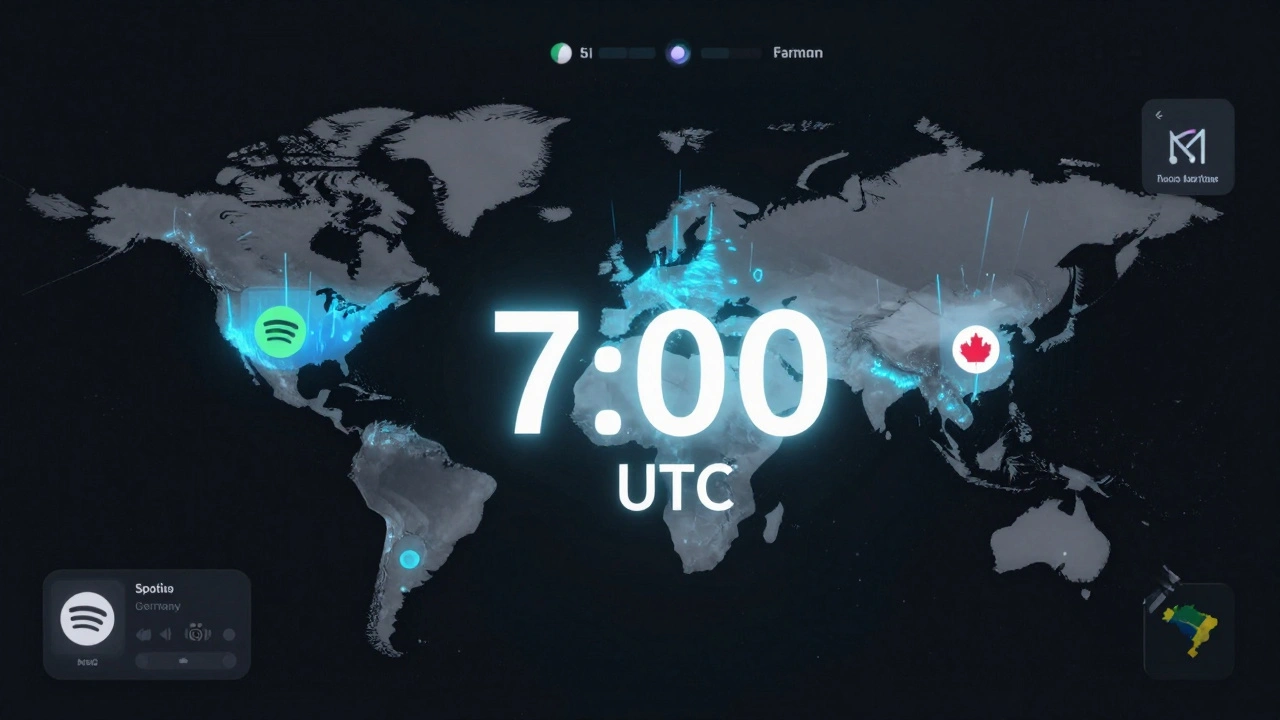
There’s no single perfect time to drop music worldwide-but there is a smart window. Based on streaming data from 2023 to 2025, the optimal global release window is 7:00 a.m. UTC.
Why? Because at 7 a.m. UTC:
- It’s 8 a.m. in London
- It’s 9 a.m. in Berlin
- It’s 2 p.m. in Dubai
- It’s 12:30 p.m. in Mumbai
- It’s 3 p.m. in Tokyo
- It’s 11 p.m. the night before in Los Angeles
- It’s 1 a.m. on the same day in Sydney
This means fans in Europe, the Middle East, and Asia wake up to your music. Fans in North America get it the night before, when they’re still online. Fans in Australia get it early enough to share before their workday starts. You’re not just releasing music-you’re triggering a chain reaction.
Most major labels now use this window. Independent artists who stick to midnight EST or midnight GMT are playing catch-up.
How to Set Your Release Time Correctly
Here’s how to get it right-step by step:
- Know your top markets. Check your streaming analytics. Which countries have the highest plays, saves, and shares? Don’t guess-look at the data from your last release.
- Convert to UTC. Use a time zone converter (like timeanddate.com) to find what time it is in each top market when it’s 7 a.m. UTC.
- Check local holidays and events. Dropping music on a national holiday in Brazil? You’ll miss the peak. Same with exam weeks in South Korea or Ramadan in Indonesia. Adjust if needed.
- Set the release date in your distributor. Whether you’re using DistroKid, TuneCore, or CD Baby, there’s a setting for release time. Choose “Custom Time” and enter 7:00 UTC. Don’t pick “Midnight” or “Local Time.”
- Confirm with your team. If you have a manager, PR person, or label rep, make sure they’re on the same page. A miscommunication here can delay your whole campaign.
Pro tip: Always schedule your release 12 hours before your target time. That gives platforms time to process and push the track live. If you set it for 7 a.m. UTC, schedule the upload for 7 p.m. UTC the day before.
What Happens When You Ignore Time Zones
Ignoring time zones isn’t just a small mistake-it’s a strategic failure. Here’s what happens:
- Missed first-day spikes. The algorithm rewards early engagement. If your biggest fanbase isn’t listening at launch, you won’t get playlisted.
- Slower social momentum. Fans on Instagram, TikTok, and Twitter won’t see your release until hours later. That means fewer shares, fewer duets, fewer memes.
- Competitor advantage. If your rival drops at 7 a.m. UTC and you drop at midnight EST, they’ll dominate the first 12 hours of global discovery.
- Lost revenue. Streaming payouts are calculated per play. A delayed launch means fewer plays in the critical first 24 hours-and that’s where most earnings happen.
One artist in Berlin released her EP at midnight CET in 2025. She expected a strong European launch. Instead, she got 800 streams in Europe and 2,100 in the U.S.-because her U.S. fans were awake at 6 p.m. local time and had already started sharing before her European audience even woke up. She didn’t realize she’d accidentally targeted the wrong time zone.
Tools That Make Global Scheduling Easy
You don’t need to be a tech wizard to get this right. Here are the tools that make it simple:
- DistroKid - Lets you set custom release times down to the minute in UTC.
- TuneCore - Offers a global release calendar with time zone suggestions.
- Spotify for Artists - Shows you where your listeners are located. Use this to prioritize.
- Time.is - A free site that shows the current time in 100+ cities. Perfect for double-checking.
- Google Calendar - Set a reminder for 7 a.m. UTC the day before your release. Add a note: “Confirm release time in distributor.”
Pro tip: Save a template in your calendar called “Global Release Checklist.” Include the steps above. Use it every time. No exceptions.
Real-World Example: How a Small Artist Went Global in 48 Hours
Meet Jax Rivera, a producer from Portland. His track “Midnight Drive” dropped in January 2025. He didn’t have a label. He didn’t have a budget. But he did have data.
He checked his Spotify stats from his last release. Top markets: Germany (28%), Japan (22%), Canada (19%), Brazil (14%). He calculated: 7 a.m. UTC = 8 a.m. in Berlin, 4 p.m. in Tokyo, 2 a.m. in São Paulo, 2 a.m. in Toronto. He scheduled the release for 7 a.m. UTC.
Within 24 hours, “Midnight Drive” hit the top 10 trending in Germany and Japan. By day three, it was on Spotify’s “New Music Friday” in 12 countries. He got over 250,000 streams in the first week. No ads. No influencers. Just perfect timing.
He didn’t get lucky. He got strategic.
Final Rule: Never Release on a Weekend
Weekends are great for listening. But they’re terrible for algorithmic discovery. Most playlist curators and editorial teams don’t work weekends. That means your song won’t get featured. It won’t get promoted. It won’t get pushed.
The best day to release globally? Thursday.
Why Thursday? Because:
- Friday playlists get curated on Thursday afternoon.
- Weekend listeners have time to discover and share.
- Monday morning algorithms still have fresh data to work with.
- It avoids the Tuesday and Wednesday clutter of other releases.
Combine Thursday + 7 a.m. UTC = your best shot at global dominance.
What’s Next? Build a Global Release Calendar
Don’t treat each release like a one-off. Build a rhythm. Plan your next three releases. Map out your top markets. Set your time zone rules. Stick to them.
Think of your music like a global event-because it is. You’re not just putting out a song. You’re creating a moment. And moments need timing. Precision. Strategy.
Stop guessing. Start scheduling.
What time should I release my music globally?
The best global release time is 7:00 a.m. UTC. This ensures your music drops during waking hours in Europe, Asia, and the Middle East, while still being late enough the night before for North America and early enough for Australia. It maximizes first-day engagement across all major markets.
Do I need to release on a specific day of the week?
Yes. Thursday is the most effective day for global releases. Playlist curators at Spotify, Apple Music, and YouTube Music finalize their weekly picks on Thursday afternoon. Releasing on a Thursday gives your track the best chance to land on key playlists and benefit from weekend listening.
Can I release at midnight in my local time zone?
You can, but you shouldn’t unless your entire fanbase lives in one time zone. Releasing at midnight EST, for example, means it’s 5 a.m. in London and 1 p.m. in Tokyo-when most people are either asleep or at work. You’ll miss peak engagement windows and reduce your chances of getting algorithmic boosts.
How do I find out where my listeners are?
Use Spotify for Artists or Apple Music for Artists. Both show you real-time listener data by country. Look for the top 3-5 markets. Then use a time zone converter to see what time it is there when it’s 7 a.m. UTC. That’s your target window.
What if my distributor doesn’t let me choose the release time?
Most major distributors (DistroKid, TuneCore, CD Baby) allow custom time settings. If yours doesn’t, switch. A distributor that doesn’t let you control release timing is holding back your global potential. Your music deserves better than a one-size-fits-all release.