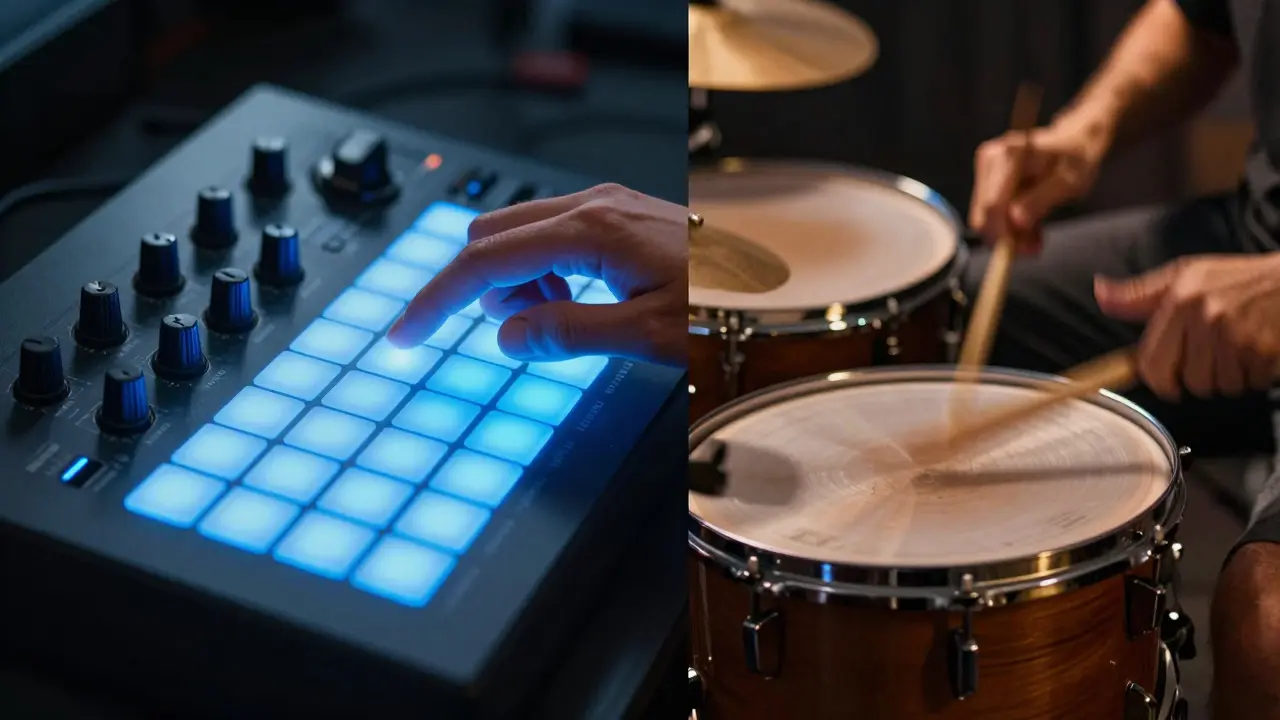
There is a persistent myth in the studio that you must choose between the precision of a computer and the soul of a human. But if you have ever tried to get a quantized loop to feel like it breathes, or convinced a drummer to play exactly on the grid without sounding robotic, you know the reality is messier. The debate isn't about which is "better." It's about which tool solves the specific problem at hand. Whether you are working with a limited budget, a tight deadline, or a specific sonic aesthetic, understanding the trade-offs between drum programming and recording live kits is the difference between a track that feels sterile and one that connects with listeners.
The Core Difference: Control vs. Character
At its heart, Drum Programming is the process of creating rhythmic patterns using digital audio workstations (DAWs) and software instruments. You are placing hits on a timeline. You can nudge every single hit by milliseconds. You can layer ten different snare samples until they sound exactly how you want them to. This level of control is unmatched. If you need a kick drum to hit precisely on beat one and the hi-hat to lag by exactly 10 milliseconds, programming gives you that surgical precision.
Live Drums, on the other hand, introduces variables that computers struggle to replicate. A human drummer plays with micro-timing, dynamic swells, and physical interaction with the kit. When a stick hits a mesh head or a wood shell, the resonance is complex. No amount of sample layering perfectly captures the way a room reacts to a crash cymbal played with a certain velocity. Live drums bring "imperfection," which is often what makes music feel alive to our ears.
When to Choose Drum Programming
Programming isn't just for electronic music. It is the backbone of modern pop, hip-hop, and rock productions where consistency is key. Here is when you should reach for your DAW:
- Genre Specifics: In genres like Trap, House, or EDM, the rhythm is often mathematical. The 808 bass line needs to lock in tightly with the kick. A live drummer rarely plays with that kind of rigid syncopation unless specifically trained for it.
- Budget Constraints: Hiring a professional session drummer costs money. Booking a studio costs more. If you are producing from home, programming allows you to create high-quality rhythms without leaving your desk.
- Sound Design: Want a snare that sounds like a gunshot? Or a hi-hat that shimmers like glass? Sample libraries allow you to build these sounds from scratch. Finding a real snare drum that sounds exactly like a synthesized 909 is difficult; designing one is easy.
- Iterative Workflows: If you are writing songs fast and changing tempos frequently, re-recording a live drum track takes time. Dragging and dropping MIDI notes takes seconds.
When Live Drums Win
Despite the convenience of software, there are scenarios where a human behind the kit is non-negotiable.
- Dynamic Range: Ballads and rock songs often require subtle dynamic shifts. A drummer can hold back during the verse and explode during the chorus with natural phrasing. Mimicking this dynamic arc in a DAW requires significant manual automation work.
- Texture and Noise: Real drums produce stick noise, pedal thumps, and cymbal wash. These "flaws" add texture. In a dense mix, these small noises fill out the frequency spectrum in a way that clean samples sometimes lack.
- Complex Rhythms: While programmers can handle complex time signatures, a skilled drummer can improvise fills and variations that keep a song interesting over multiple choruses. Programmed loops tend to repeat identically unless manually varied.
- Band Context: If you are recording a full band, having a live drummer in the room creates a shared energy. The guitarist hears the drummer, the bassist locks with both. This interplay is hard to fake when tracks are recorded in isolation against a click track.
The Hybrid Approach: Best of Both Worlds
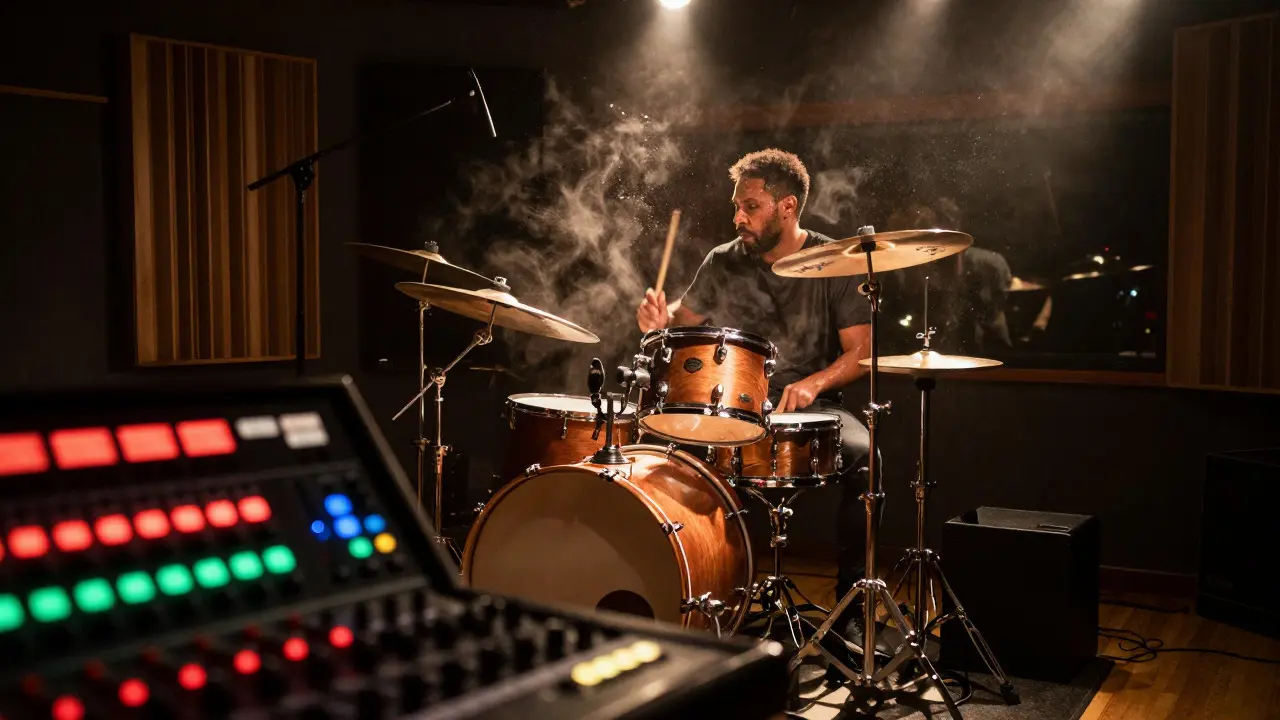
Most professional producers don't pick one side. They use a hybrid workflow. This involves recording a live performance to capture the feel, then editing it heavily in the DAW. Or, starting with a programmed groove and triggering it with a live performance to add dynamics.
Consider the technique of "humanizing" MIDI data. You can take a perfectly quantized pattern and apply randomization to the timing and velocity. This adds a slight wobble that mimics human error. Conversely, you can record a live drummer playing loosely, then use elastic audio tools to tighten up the timing without making it sound robotic. The goal is to find the sweet spot where the rhythm feels intentional but not mechanical.
| Feature | Drum Programming | Live Drums |
|---|---|---|
| Precision | High (Millisecond accuracy) | Low (Natural variation) |
| Sonic Texture | Clean, designed, consistent | Organic, noisy, complex |
| Cost | Low (Software only) | High (Session fees + Studio) |
| Editability | Extremely Easy (MIDI) | Moderate (Audio Editing) |
| Best For | Electronic, Hip-Hop, Pop | Rock, Jazz, Soul, Folk |
Technical Considerations for Mixing
Mixing programmed drums and live drums requires different approaches. Programmed drums are often very dry and punchy because they are sampled from close-miked sources. They sit well in a mix but can sound thin if overused. You might need to add reverb or delay to help them blend into the rest of the track.
Live drums come with room mics already baked into the signal. This gives them width and depth. However, it also means you have to deal with bleed (sound from one mic leaking into another). If your snare mic picks up too much kick drum, phase issues can arise when you try to EQ the individual tracks. Learning to manage phase alignment is a critical skill when working with live multi-track recordings.
Common Pitfalls to Avoid
One major mistake is relying entirely on quantization. If every hit is snapped to the grid, the song loses its groove. Even in electronic music, leaving a few hats slightly off-beat creates a sense of movement. Another pitfall is ignoring the low end. Programmed kicks can be too boomy if not carefully EQ'd. Live kicks vary in tone depending on the player's foot speed. Always check your low-end balance in mono to ensure no mud builds up.
Finally, don't let technology dictate the vibe. If a live drummer is playing brilliantly but is 5 milliseconds late, listen to it before you fix it. Sometimes the "mistake" is the best part of the performance.
Frequently Asked Questions
Is drum programming easier than recording live drums?
Technically, yes. Programming requires less setup and no personnel costs. However, mastering the art of making programmed drums feel human is a complex skill that takes years to develop. Recording live drums is physically demanding for the engineer and drummer, but the raw material is often more musically compelling right out of the box.
Can I make rock music entirely with programmed drums?
Yes, many successful rock and metal bands use programmed drums or hybrid setups. Bands like Tool or Nine Inch Nails have used extensive sampling and programming. The key is to ensure the dynamics match the intensity of the guitars and vocals. If the guitars are aggressive, the drums need to match that energy, which can be achieved through careful velocity mapping in your DAW.
What is the best way to combine live and programmed drums?
A common technique is to record the live drummer playing the main groove, then program additional layers like extra hi-hats, percussion, or electronic kicks to fill gaps or add punch. This gives you the organic feel of the live performance with the clarity and power of digital samples. Make sure to align the transients so the live and programmed elements hit at the same time.
Do I need expensive drum samples?
Not necessarily. Free sample packs can be excellent if you know how to process them. Layering two or three cheap samples together often sounds better than one expensive one. The secret is in the processing: compression, EQ, and saturation can transform basic samples into professional-sounding drums. Focus on how the samples fit in your mix rather than their initial price tag.
How do I make programmed drums sound less robotic?
Vary the velocity (volume) of each hit. Humans never hit a drum with the exact same force twice. Add slight timing offsets to off-beat notes. Use swing settings in your DAW to shift even or odd notes slightly. Finally, add room reverb or delay to give the drums space. These small adjustments break the mechanical pattern and introduce a human-like flow.